May 16, 2008
Archive for Books
August 2, 2007 at 6:00 am · Filed under Books, Competitions, What is Kabbalah?
We are continuing the “Misconceptions of Kabbalah” posts with this one on numerology…
PART OF AN ENTRY SENT BY MARY DARE: I thought the Kabbalah had something to do with Numerology. Since I had never been good with numbers, I stayed away from it…
Numerology and Kabbalah

FROM THE BOOK: The term numerology did not exist in authentic Kabbalah; contemporary scholars linked the two. Although numerology is not an accurate term to describe Kabbalah’s treatment of numbers, there is probably no better word to use if you want to translate the Hebrew term Gimatria into English.
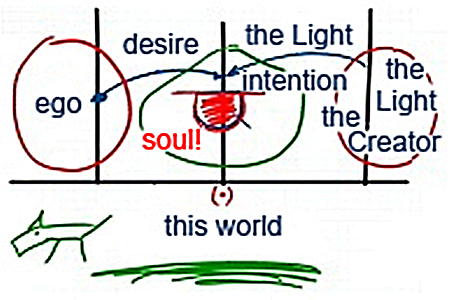
Gimatria, in simple terms, describes a Kabbalist’s experience of the divine. In Kabbalah, the ego performs Yihudim (unifications) with the Creator. The shape of Hebrew letters depicts such unifications through dots and lines over a white background. The dots and the lines symbolize the states of the Kabbalist, who perceives the Creator. The white background symbolizes the divine light, the Creator.
In Hebrew, each letter of the 22-letter alphabet is assigned a specific number… The correlation between letters and numbers created a way for Kabbalists to describe to each other what they experienced in a concise and accurate manner. For example, the word Nega (affliction) and the word Oneg (pleasure) have the exact same letters (in a different order) and, therefore, the same numeric value. The inversion in the order of letters indicates that when affliction is corrected (from egoism to giving), a person experiences pleasure.
p. 11 in The Complete Idiot’s Guide to Kabbalah by Rav Michael Laitman, PhD and Collin Canright.
Share This
July 29, 2007 at 5:07 am · Filed under Altruism, Books, Disclosure of Kabbalah, Quotes

Kabbalah for idiots, genius’s, the poor, the tired…
A person can be old or young, have all sorts of qualities, be smart or foolish - this is not important. His soul operates beyond all these properties and its functioning does not depend on them. A person may not have a sharp mind, and still be a great Kabbalist, yet he also can be very successful, clever, but at the same time be an angry and rude person. more…

Happiness
Happiness does not always mean some event that puts a big smile on our faces. It means moving toward goals that help us live the kind of life we think is in our best interest at the time. So that is the sense in which our actions are always aimed at making ourselves “happy.” (p. 35, “The Pleasure and Pain Principle” from The Complete Idiot’s Guide to Kabbalah)

Do You Really Want Spirituality?
A famous story about the Ari’s students demonstrates just how ripe the Ari believed the time was. One day he said to his students, “If we all go to Jerusalem [they were in a different city then], we will bring the end of correction, and reach the highest degree. We need only do it together.” Alas, most people couldn’t come: one had a sick child, another couldn’t come to terms with his wife and she wouldn’t let him go, and another just didn’t have the energy for such a long walk. They stayed in their town, and the end of correction stayed away from us. But the Ari believed that it was possible. (p. 55, “Debunking the Myths” from The Complete Idiot’s Guide to Kabbalah)

Self-Examination
Kabbalists explain that all creations are sensing beings. In other words, all we have are our feelings and emotions. This is because the purpose of creation is for us to feel pleasure. Even our rationale exists only to justify, to rationalize our feelings. Therefore, if you want to study yourself, examine your emotions. See what gives you pleasure - you’ll be surprised, and not always pleasantly. (p. 160, “Kabbalah and Your Life” from The Complete Idiot’s Guide to Kabbalah)

Body and Soul
It’s not the body that needs correction. It’s the soul. (p. 181, “Praying with Results” from The Complete Idiot’s Guide to Kabbalah)

Altruism - Rising to the Challenge
In all this havoc of egoism, we are forgetting the roots of creation. We are one soul. It doesn’t matter how many innocent people die; we will still be one soul.
In writings that were given the name “The Last Generation,” Rabbi Yehuda Ashlag wrote that if we don’t change the course of events, we will experience a third and a fourth world war. The relics, he wrote, will still have to do the job and correct our egos. We must realize that there is a crisis, and we must deal with it in the only way possible: through rising to the level of nature’s altruism. (p. 245, “The Malady: Trapped in the Ego Cage” from The Complete Idiot’s Guide to Kabbalah)
Share This
July 26, 2007 at 7:00 am · Filed under Books, Quotes, Thought of the Week

Following are some quotes of prominent Kabbalists to help inspire you during your day or before you go to sleep. Read them one at a time, then contemplate. There is no rush; these quotes work best when you think about them for a while.
“All of man’s engagements are guided by a single, intrinsic premise, and the internality dresses within all people. It is what they referred to as “Nature,” whose numeric count is the same as Elokim (God). And this is the truth that the Creator concealed from the philosophers.”
—Rabbi Moshe Chaim Lutzato (The Ramchal) (1707—1747), The Book of the War of Moses
“Man’s future will indeed come, in which he will evolve to such a sound spiritual state, that not only will every profession not hide another, but every science and every sentiment will reflect the entire scientific sea and the entire emotional depth, as this matter really is in the actual reality.”
—Rabbi Abraham Yitzhak HaCohen Kook (1865—1935), Orot Kodesh, A (Holy Lights, A)
“One who feels within, after several attempts, that one’s soul within is in peace only when engaging in the secrets of Torah, should know for certain that this is what one has been made for. Let no preventions—corporeal or spiritual—stop one from running to the source of one’s life and true wholeness.”
—Rabbi Abraham Yitzhak HaCohen Kook (1865—1935), Orot Kodesh, A (Holy Lights, A)
“The Torah was given to learn and to teach so that all will know the Lord, from least to greatest. We also find many books of Kabbalists alerting of the importance of the study of the wisdom that everyone must learn.”
—Rabbi Yitzhak Ben Tzvi Ashkenazi (???—1807), The Purity of Sanctity
“Indeed, if we set our hearts to answer but one very famous question, I am certain that all these questions and doubts will vanish from the horizon, and you will look unto their place to find them gone. This indignant question is a question that the whole world asks, namely, ‘What is the meaning of my life?’”
—Rabbi Yehuda Leib HaLevi Ashlag (Baal HaSulam) (1884—1954), The Study of the Ten Sefirot
“Even when one does not have the vessels, when one engages in this wisdom, mentioning the names of the Lights and the vessels related to one’s soul, they immediately shine upon us to a certain measure. However, they shine for him without clothing the interior of his soul for lack of the able vessels to receive them. Despite that, the illumination one receives time after time during the engagement draws upon one grace from above, imparting one with abundance of sanctity and purity, which bring one much closer to reaching perfection.”
—Rabbi Yehuda Leib HaLevi Ashlag (Baal HaSulam) (1884—1954), The Study of the Ten Sefirot
pp. 193-4, part “Kabbalah and Your Life,” chapter “Correction Is a Matter of Intention” in The Complete Idiot’s Guide to Kabbalah by Rav Michael Laitman, PhD with Collin Canright.
Share This
June 14, 2007 at 1:39 pm · Filed under Books, Competitions, Definitions, What is Kabbalah?

We are continuing to post responses to the “Misconceptions of Kabbalah” competition…
ENTRY SENT BY JANNET: My encounter with Kabbalah was when I went to the library and out of curiosity borrowed the book entitled “Qabbalah Magic.” It told of what magic you can achieve and things you can acquire by performing all these rituals. However I didn’t finish the book as I felt it wasn’t what I was looking for.
Myth: Kabbalah Is All About Magic

FROM THE BOOK: It is a common mistake for people to think that Kabbalah deals with fortune telling, revelations of the past, and the study of the present. The definition of Kabbalah is the revelation of the Creator to people in this world today, not after death. Perhaps some draw this parallel as a result of the perception of secrecy that surrounds Kabbalah.
Either way, Kabbalah has no connection to magic. In fact, Kabbalah forbids fortune telling or any attempt to find out about the destiny of the physical body. The body is temporary, negligible, and, thus, insignificant. It is not worthy of attention beyond the question of how it serves the soul.
pp. 55/6 in The Complete Idiot’s Guide to Kabbalah by Rav Michael Laitman, PhD and Collin Canright.
Share This
June 7, 2007 at 8:40 am · Filed under Books, Competitions, What is Kabbalah?
We wish to thank everyone who sent their entries for the “Misconceptions of Kabbalah” competition. All the entries made it clear that everyone’s spiritual path is equally unique, and no entry could be decided to be more or less unique than another.
We will continue featuring various entries in the daily Kabbalah Blog posts (Click here to receive them in your e-mail) and in the newsletter (subscribe on the right of this screen).
The following entry, sent by David D. Garcia of New York, was chosen to receive the free copy of The Complete Idiot’s Guide to Kabbalah because it most closely fits the Jewish themes of this week’s newsletter and the new issue of Kabbalah Today.
WINNING COMPETITION ENTRY: As a Jew, my biggest misconception of Kabbalah before encountering Bnei Baruch was that I had to be fully ‘Torah Observant’ before being able study Kabbalah. I was always taught that one must have an extensive background in Torah and Talmud before even contemplating Kabbalah. I always accepted this because I had always assumed Kabbalah was ‘only for Jews’, and further, only for ‘observant’ Jews.
Once I learned through Bnei Baruch that it is essential for all people to study Kabbalah, this discovery made me begin to question my preconceived ideas of prerequisites to Kabbalah study. And it was through Bnei Baruch that I came to understand that Torah, and perhaps to a ‘lesser’ extent, Talmud, can only be properly understood through a Kabbalistic lens. This allowed me to dispel all my previously held ideas and begin to Kabbalah study in earnest. Thank you!
Myth: Kabbalah Is a Religion

FROM THE BOOK: This is a common misunderstanding, and one worth addressing from the start. The wisdom of Kabbalah is related to no other religion or belief. It does not deal with meditations, prophecies, questions of religion, or even one’s mental state. Religions, however, are combinations of rituals designed by humans to support them in their earthly existence. While religions such as Judaism and Christianity have similar concepts of the Upper World (heaven, the afterlife, etc.), much of religion teaches how humans should exist in this temporal world.
Kabbalah, however, is better thought of as a science, not a religion. As such, Kabbalah studies and provides a way of understanding of the essential core of humanity, the Higher World, the entire universe, and the Creator. The outcome of that study is the discovery that humankind wishes to become like the Creator. The wisdom of Kabbalah is the science of the system of creation and its management.
pp. 53/54 of The Complete Idiot’s Guide to Kabbalah, by Rav Michael Laitman, PhD and Collin Canright.
Share This
May 31, 2007 at 1:49 pm · Filed under Books, Competitions, What is Kabbalah?

Part 1 of The Complete Idiot’s Guide to Kabbalah explains the general phenomenon and its popularity, and gives an overview of what exists today in the world regarding the word Kabbalah. It also discusses what Kabbalah is and what it isn’t, and gives some background on how it got started.
We have been receiving many responses to the competition showing the many misconceptions we all have about Kabbalah prior to encountering the authentic study through Bnei Baruch. We will post some of these coupled with explanations about these misconceptions from Part 1 of The Complete Idiot’s Guide to Kabbalah in coming newsletters and blog posts.
Next Thursday we will publish the winning entry. You still have until Monday, June 3, 2007 to enter! Send all entries to english@kabbalah.info
Click here to pre-order your copy today!
——————————————————————————–
Meditation and Kabbalah
The Meditation Misconception
COMPETITION ENTRY FROM BB STUDENT PAULA BARUCH: Prior to coming to Bnei Baruch to learn what the wisdom of Kabbalah really is, I spent 12 years intensely studying Judaism and so-called “Kabbalah.”
My biggest stumbling block was meditation and so-called “Kabbalistic meditation.” I fully expected to attain the upper worlds by sitting in stillness with my eyes closed and chanting various permutations of names of G-d. All my closest “divine” connections came from my meditation practice and that was my ultimate pleasure, that sweet “divine connection.”
Imagine my surprise and shock to learn that meditation was actually reducing me to the level of a stone! Sure I could feel the divine, but in the same way a stone does
It was like settling for the teeny-tiniest fragment of the upper light. Now I wrestle to become a fully speaking human in this world, thanks to Bnei Baruch.

FROM THE BOOK: Meditation is considered by many as part of the spiritual work or practices of a Kabbalist. But not all Kabbalists have practiced meditation, and even those who did meditate did not practice it in the sense we do today.
Today meditation is associated with Eastern teachings, something that Kabbalists in the past did not know. Generally, Eastern meditation is used for relaxation and for uniting with higher levels of existence by “removing” the ego. In Kabbalah, the ego is not removed, but elevated to a higher level of practice. It connects with the divine instead of canceling itself. This embrace of ego and Creator is called Yihud (unification).
pp. 10/11 of The Complete Idiot’s Guide to Kabbalah, by Rav Michael Laitman, PhD and Collin Canright.
Click here to view a related video: “Can a Kabbalist also be a Buddhist?”
Share This
May 17, 2007 at 8:11 pm · Filed under Books, Competitions, Notices

One of the purposes of The Complete Idiot’s Guide to Kabbalah is to clear up any misconceptions a person has about what Kabbalah is and what it can do for you; misconceptions that developed during the 2,000 years of its concealment.
In order to win a free copy of The Complete Idiot’s Guide to Kabbalah, please send us (in 250 words or less) a short story about your biggest misconception of Kabbalah prior to encountering authentic Kabbalah at Bnei Baruch.
The sender of the most unique answer will receive a free copy of the book, and the answer will be published in the newsletter and Kabbalah Blog post of Thursday, June 7, 2007.
Closing date for entries is Monday, June 3, 2007. Send all entries to english@kabbalah.info
Click here to pre-order your copy today!
Share This
May 17, 2007 at 8:10 pm · Filed under Books, News, Notices

You’re no idiot, of course. You know that Kabbalah is more than a celebrity fad or a red string bracelet. Its philosophies encourage us to look beyond the tangible for purpose and enlightenment.
The Complete Idiot’s Guide to Kabbalah will show you exactly how to embrace these ancient teachings - and make them a part of your daily life. In this Complete Idiot’s Guide, you get:
- The facts - and fallacies - about Kabbalah.
- Enlightening advice on how to read the Bible or Torah from a Kabbalah point of view.
- Down-to-earth guidance on how to incorporate the essence of Kabbalah into everyday life.
- The story of creation according to Kabbalah.
The Complete Idiot’s Guide to Kabbalah is Rav Michael Laitman’s first book written in English as an original language. Together with writer Collin Canright, this author duo produced a book rich with analogies, examples and alerts to explain this most ancient wisdom in the simplest way possible to the Western world.
Click here to pre-order your copy today!
Share This
« Previous entries