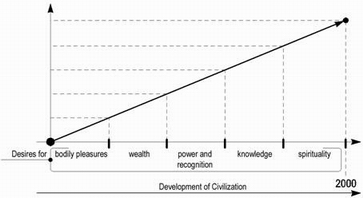
Kabbalists discovered that our desires for pleasure evolve by 5 stages:
1) The first, and most basic desire, is the desire for food, health, sex, and family. These are necessary desires for our survival.
2) The second stage is the aspiration for wealth. Here we think that money guarantees survival and a good quality of life.
3) The third is the craving for honor and power. Here we enjoy controlling others, as well as ourselves.
4) In the fourth stage appears the desire for knowledge. Here we think that having knowledge will make us happy.
5) But only when the fifth, and last stage of desire appears, we become attracted to an unknown “something” that is beyond us. Here we feel that connecting to this unknown “something” can bring us greater and lasting enjoyment, and we search for ways to make this connection. This desire for something higher is called “the desire for spirituality.” more…
The upcoming February 2008 International Kabbalah Congress in Tel Aviv, Israel was initially planned as a closed congress for students of Bnei Baruch, but plans have changed. The original entry requirement was that one had to prepare oneself internally, together with the daily lessons (on Kabbalah TV) and texts provided (see the Kabbalah Group blog), with the aim of crossing the boundary between this world and the spiritual world, together with others from around the world who have undertaken this same preparation.
Now, due to popular demand, the congress’s doors have opened to anybody who wants to participate. “We have seen that it is impossible to keep this congress closed. Lots of people, whom we haven’t been in contact with in the past, are registering from all over the world,” stated Igal Reznik, Bnei Baruch student from Israel who is coordinating the congress’s cultural events.
“Now everyone who feels a closeness to the need for achieving unity among humanity can participate. It doesn’t matter whether they are a veteran Kabbalah student or a beginner - there is nothing to be afraid of. The only thing a person needs is to open their heart,” Reznik continued.
Everybody who wants peace, happiness, wholeness and perfection to encompass humanity, is invited to the upcoming 2008 International Kabbalah Congress in Tel Aviv, Israel! Click Here for More Information and Registration
Bnei Heichala means “the sons of King’s Palace,” those desiring to reach the Palace of the King. The King’s Palace is Bina—the property of bestowal, the force of the Creator, the spiritual. The sons are those who yearn to resemble the King in their properties, to become like Him. The word for “Son” (Ben) derives from the word for “understands” (Havana). They yearn to understand the King, and though their understanding, come closer to Him and feel Him.
Hence, Bnei Heichala are the souls aspiring to attain the state of uniting the King in His Palace, and to do so, they are ready to pass the entire system of corrections, change themselves from the beginning until the end—from the nature in which they were created to the nature of the King, as it is written: “Returned the sons of Israel to the height of their God.” This is what this song is about.
* FILM: Melodies of the Upper Worlds - Part 1 - features melodies of the 20th century’s greatest Kabbalist, Baal HaSulam, with explanations of how these melodies relate to the inner, personal quest for discovering the Upper Worlds—the source of our existence.
When a Kabbalist experiences the Upper World, he or she enters another realm of reality. Past, present, and future merge into a single stream of life, and the Kabbalist experiences all the souls united in the eternal love of the Single Force that operates and governs life.
But most of all, a Kabbalist discovers that being in the spiritual reality is possible only through the bond of love between the Kabbalist and all other souls. It is for this love that Kabbalists try so diligently to share their spiritual experiences with us. Their sole wish is that we, too, will discover and feel the kind of life offered when we bond with the Creator of reality. In their songs, they call this “being filled with the Upper Light.” more…
BLOOMBERG TV (October 24, 2007): Mike Schneider, on Bloomberg’s “Night Talk,” interviewed Rav Michael Laitman, PhD investigating Kabbalah from a variety of angles. The interview was composed of 3 parts, each detailing a specific angle on Kabbalah:
Part 1: The Mystery Surrounding Kabbalah
• Kabbalah – What Is It?
• An Ancient Wisdom that Predates Judaism
• Kabbalah and Judaism – What Is their Connection (if any)?
• Is there One Individual Figure Who Occupies a Position of Leadership in Kabbalah?
• Prophecy – Is there such a thing in Kabbalah?
Part 2: The Buzz Surrounding Kabbalah
• Madonna in Kabbalah – What’s the Deal?
• Ethics – Why We Don’t Need Them
• Science and Kabbalah – Are they Competitive or Complementary?
• Kabbalah Involves No Rituals of Any Kind
• Kabbalah Is a Method. Is it a Philosophy as Well?
• You Don’t Need to be Trained in Traditional Judaism Before Studying Kabbalah
Part 3: The Modern World Surrounding Kabbalah
• World Problems. Their Causes. Their Solutions.
• Improve Personal Behavior, Relationships and Family Connections
• Terrorism – the Source of the Problem (Is the Same Source as Every Problem)
• Philosophers and Kabbalah
• What Is the Main Change that Happens to You When You Study Kabbalah?
What began as a daily Kabbalah lesson with Rav Michael Laitman, PhD turned into a 2-and-a-half-hour long question-and-answer super session on the subject of education—its crucial state in our world today, and how to optimize education for our following generations.
Bnei Baruch are now clarifying a new system of education based on revised study methods, new teacher requirements, how to train the world’s next generation of leaders, how to use media and globally-connected technologies in the most beneficial way for humanity’s development, and how to fulfill the educational needs of our future generations.
Listen to the file by clicking on the Flash player’s button below:
FOX NEWS RADIO (October 24, 2007): Todd Starnes, from the radio show “A Few Moments With,” interviewed Rav Michael Laitman, PhD on
* What is Kabbalah?
* Is Kabbalah is a religion?
* Is it possible to study Kabbalah if you are a Christian, Muslim, or Jewish?
* How connected are celebrities to Kabbalah?
* Why are people getting attracted to Kabbalah in our world today?
* What can the average American family living in the suburbs get from Kabbalah?
* What is fun about studying Kabbalah?
November 19, 2007 at 12:01 pm · Filed under Meditation
Question: For several years now, I have been practicing Kabbalistic meditation. I took some courses on the subject and I’m using a book by Rabbi Chaim Vital for this purpose. But lately, I’ve been reading in your paper that there is no such term as “Kabbalistic meditation.” How is this possible if Rabbi Vital writes specifically about that term?
Rav Michael Laitman, PhD: First, note that no such term as “meditation” or anything like it appears in even a single authentic Kabbalah book. Additionally, the act that all kinds of courses and study groups call “Kabbalist meditation” doesn’t exist in Kabbalah. All the writings of Kabbalah, including those of the Ari—which were written by Rabbi Chaim Vital—explain one simple thing: the whole of Creation is made of a desire to enjoy. That desire can only be in one of two states: corrupted—with an intention to receive for itself, or corrected—with an intention to give, to love others.
Question: What does this have to do with Kabbalistic meditation?
Rav Michael Laitman, PhD: In the process of the correction of the soul, a Kabbalist uses a method called “three lines.” This method is built on a simple procedure: first, the Kabbalist “takes” part of the corrupted (egoistic) desire, called “the left line” and subsequently corrects it, using the force of the spiritual Light, called “the right line.” In doing so, the Kabbalist builds a “middle line” within the soul, and thus advances in spirituality.
Because this work concerns changing one’s intention from reception to bestowal, it is called “work in intention” or “intention work.” One who is not proficient in the wisdom of Kabbalah misinterprets the term “work in intention” and attaches it to terms that are completely foreign to Kabbalah, such as meditation.
November 15, 2007 at 10:07 am · Filed under Audio, Books
Kabbalah, Science & the Meaning of Life traces the milestones of the evolution of science with which we are familiar, such as Newton’s and Einstein’s theories but goes further to present the science of Kabbalah as the basis for understanding the hidden parts of reality which scientists are now discovering. While other sciences research the definable world around us, Kabbalah teaches us how the spontaneous changes occurring within us affect our surrounding reality. The wisdom of Kabbalah enables us to monitor those changes and control them, and in so doing change our world for the better.
Audio Files (MP3) - Every Link Is One of the Book’s Chapters:
November 13, 2007 at 12:21 pm · Filed under Events
February 3 – 6, 2008: Friends from around the world are invited to participate in the 7th Annual Bnei Baruch International Kabbalah Congress in Tel Aviv, Israel.
Welcome to the official Kabbalah Blog of the Bnei Baruch Kabbalah Education & Research Institute. Here you will find all the latest Kabbalah articles, videos, audio, news, features, Bnei Baruch website updates and content additions.
Kabbalah Newsletter
Fill out your e-mail address
to receive Bnei Baruch's weekly newsletter!