“We are here to create a better world…people who care enough, can change the course of history…”
Abby Hoffman, 1967
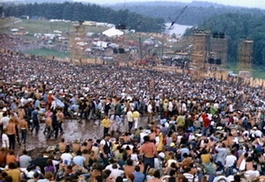
Precisely forty years ago, in the summer of ‘69, in a void between the Vietnam War and Neil Armstrong’s small/giant step/leap on the moon, an exceptional event changed the face of the world. Or at least it meant to.
It all began with an “innocent” ad, featuring a guitar and a little dove telling of an upcoming music festival. The rumor rapidly spread throughout America, and thousands of youngsters began flowing to the green fields of Max Yasgur, a Jewish farmer, north of New York State. Something took place, which no one had imagined, including the original festival’s organizers.
What actually happened? Superficially speaking, not much. No historical battles, no extraordinary speeches, no victims or dead (except for one poor hippy who was run over by a heartless tractor). A few thousand people sang together, bathed nude in the lake and slid down sticky mud the rain left behind. But for the most part they united, becoming one giant, hairy ball, sweaty, wild with a spark in their eyes.
It may have been for a short period of time, but that was enough to turn the Woodstock festival into one of the most impactful and important events of the 20th century. What has changed since then? Was Woodstock just a nostalgic, passing episode, or a significant event, with relevant ramifications for our time as well?
Separately Connected
“Everything is connected together, breaking and coming together, it becomes complicated and straightens itself out again, with no connection, there’s no connection…”
Rami Fortis, “No Connection”
Undoubtedly, we are clearly in a post-Woodstock era now. It’s an era steroid-pumped with technological super-connections and high traffic information flows: reality TV, SMS, Twitter, Facebook, and auto-answering messages “connect” people. Naïve romanticism and flowers in the hair have been swapped with sarcastic realism, and if you’re lucky, a flower-themed cellphone case or screensaver. Is there even one person around anymore who believes passionately in some power-shifting revolution? And is there even any “institution” left to fight? That’s just painting a small part of the picture…
In the last ten years, probably the most significant development is that one called “globalization.” People, money and technology have crossed national boundaries, and a global community has been created. On the one hand, people are becoming connected with one another in every realm of life. But on the other hand, the ever-growing ego is ever-active in separating people, making it difficult to accept that interconnection is a fact of life. Instead of consciously choosing to come together, human “togetherness” is involuntarily evolving and pressuring people to object and to deny that which ties one another together.
This is a result of two opposite needs operating simultaneously: (1) the need to be with everyone, and (2) the need to remain in each one’s own safe haven. People feel negative sensations like pressure, stress, insecurity and paranoia as a result of these two clashing needs, and in particular, as a result of holding tight onto the second of these two needs when the first is the one demanding attention. In short, the time has come for a true connection between people to form, one beyond that felt at a Woodstock – one that incorporates humanity as a whole.
Woodstock proved that a few thousand people equipped with a strong social agenda can arouse media buzz and widespread social response. It also proved that it’s not enough to truly better the world. For that, people must become equipped with a deeper understanding of the essence of their connection. It’s insufficient for people to simply be spectators of this grand performance of the world unfolding before them. Now’s the time for people to start participating in this process, to get backstage tickets and see the making of every personal, social and global event they find themselves in. And unlike a major music event, the backstage tickets for life are free…
The Wisdom of Kabbalah – Life’s Backstage Tickets
“We are stardust, we are golden, and we’ve got to get ourselves back to the garden…”
Joni Mitchell, “Woodstock”
According to Kabbalists, humanity was initially joined as one soul, an immense body composed of infinite cells that sustained a mutual and continuous connection among them. At a certain point, that collective soul shattered into an infinite number of parts, which are you, me, and the seven billion other people in the world. This shattering brought about a complete loss of a sense of connection, and since then, people have been constantly engaged in the search for substitutes of that feeling of wholeness that each one had experienced. Woodstock is but one of the many subconscious efforts people have taken to replicate that lost connection, that gone memory. But the feeling experienced at Woodstock was short-lived, just like all efforts humanity has made toward achieving that ultimate feeling of wholeness.
The human ego has been growing and expanding over the years and is now reaching new heights. The ego leads people to impressive achievements, but in addition, opens a deep void in people’s hearts, and it successfully destroys any warm, human connection people attempt to establish. Today’s global age, Kabbalists explain, is the last phase of humanity’s preparation toward evolving into its final, preprogrammed state: its reunification as one soul, above the ego that divides one from another.
Kabbalists throughout the generations have developed the method of attaining true connection among people precisely for its use in our time, when the destructive nature of the ego would be reaching its heights of development. At the innermost core of this process is the need to change the person’s inborn egoistic nature to its opposite: the quality of giving to others.
But to anyone inexperienced with Kabbalah’s method, this would very much sound far fetched. How can people possibly give up being concerned about themselves? If anything, now more than ever it seems like each person needs to be on the lookout for him- or herself more than in any other time. If someone isn’t concerned for him- or herself, so who else will be?
With A Little Help From Friends…
“When humanity reaches its goal by attaining the complete degree of loving others, all bodies in the world will be joined into one body and one heart – only then, our desired happiness will be revealed before humanity in all its glory.”
Baal HaSulam, “The Freedom”
The renowned Kabbalist, Baal HaSulam (Kabbalist Yehuda Ashlag), claimed that the only way people could ever give up their self concern would be if others showed concern for their welfare, one for another, just like in a small family where each one takes care of the other. He called this warm relationship “the mutual guarantee,” and through such mutual consideration and dependence, the force that once united everyone as one soul will become revealed from its concealment. The establishment of this mutual guarantee will grant people freedom – freedom of concern for themselves, and the experience a new, perfect reality.
Sliding in Woodstock’s slippery mud, growing long hair and singing freedom slogans with a dry throat are unnecessary for achieving this new reality, and moreover, the human ego has expanded to such dimensions that interconnection based on slogans and acid simply cannot be achieved. The united feeling at Woodstock will never be revived, at least not in its original form. People are now required to connect with awareness, insight, and with open eyes. It’s time for everyone to take off his- and her mask, and truly connect in heart.
And it is at that point, of all places, that the world of culture and music in particular, play a major role. Why?
The Power of Music
“Each of us has a huge ego, and the only way to survive together for 31 years is to create a situation in which the group’s ego is bigger than that of each of its members….”
Bono, on the secret of the group U2’s survival for many years
Music is the deepest and most direct artistic expression. It can cross boundaries, touch people’s hearts and carry them away, and connect them beyond their differences. Music has the tendency to reject and be free of existing customs. In addition, music has become the most popular and successful artistic platform in recent times. It flows with ease through modern media pipelines – the Internet, mobile devices, radio and TV – and is available everywhere and at all times. Famous artists and musicians are still cultural heroes who greatly influence the public. The only question is, of course, how is this all translated into actual changes in the real world?
In the initial phase, people began pointing their arrows in the right direction. In the 60s, the musicians’ revolution was mainly directed against the institution in all its forms. However, as time passed, people realized that the real problem is not with the institution itself, but with the inner force that operates and motivates all people: man’s egoistic nature. The true walls needing to be broken down are those between people, the walls in people’s hearts, walls of detachment and separation from one another that tear away at each other, causing all suffering and torment in the world. That doesn’t mean that the belligerent spirit flowing in the veins of rock music should be packed away. On the contrary, that spirit needs to be used all the more forcefully, sending new arrows of revolution, sharper and smarter, towards the true enemy residing within each and every person. In other words, the ego should not be cancelled or decreased, but used with a new intention – with the intention of attaining a true and complete connection with others, a connection that presents humanity with the opportunity for a higher and more elevated existence.
Music must return to its source, to individuals, to people – as a tool that connects and glues people together, making them feel truly closer to each other. If the guitar and the dove, meaning human culture and Kabbalah’s spiritual concepts, join together, they will be able to develop a feeling of eternal and complete life in people’s hearts. This time, as opposed to the past, all knowledge, awareness and necessary internal maturity are in people’s hands in order to succeed in reconstructing a universal, internal Woodstock, the Woodstock of the souls.
Free Course in Authentic Kabbalah. Click Here to Sign Up

Thanks a lot. What a wonderfully wellcomposed article!
One thing though that comes to my mind is the role of hallucinatory drugs in this happening and the following great interest in all kind of consciousness-expanding techniques.
Rachel Roth
Stockholm, Sweden
I